Deployment architecture
Test Services is installed on every OpenLab CDS machine, but which tests it offers depends on the machine's role in the deployment. This page shows the supported topologies, the tests that appear on each machine type, and the address you use to reach Test Services in each one. For how a test actually runs, see How Test Services works.
In every topology, Test Services is made of a core framework and a CDS plug-in. The framework provides the tests that need no license (the Software Installation Verification Test and the System Report) together with the licensed Security Test and Storage System Test; these framework tests verify the underlying OpenLab platform rather than OpenLab CDS itself. The CDS plug-in adds the OpenLab CDS Connectivity Test and the licensed OpenLab CDS Workflow Test, which verify OpenLab CDS specifically. A test appears on a machine only when its component is installed and applies to that machine's role.
Workstation and Workstation Plus
On a Workstation or Workstation Plus, the full set of tests is installed: the Software Installation Verification Test, System Report, Security Test, and Storage System Test in the framework, and the Connectivity Test and Workflow Test in the CDS plug-in. The difference is licensing: Workstation Plus includes all Test Services licenses, while a Workstation enables the licensed tests through the QlaSecurity license (Security and Storage) and the workflow license (Workflow). On a Workstation (and on Clients, AICs, and Servers) these licenses must be purchased and installed separately; Workstation Plus is the only system that includes them.
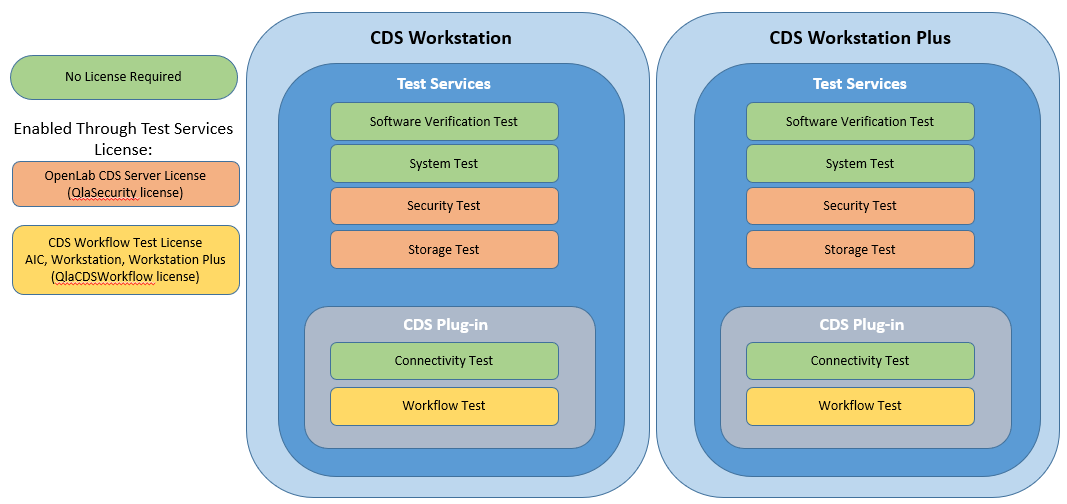
Figure 1. Test Services components on a Workstation and a Workstation Plus, color-coded by license: no license required, the QlaSecurity license, and the workflow license.
CDS Client and AIC
A Client and an Analytical Instrument Controller (AIC) split the work. The AIC runs the tests that exercise the instrument and the acquisition workflow, so the Connectivity Test and the Workflow Test are recommended there. On a Client, only the Connectivity Test is recommended; the Security Test, Storage System Test, and Workflow Test are available but not recommended. The Security and Storage System tests are verified from a server rather than a client, and the Workflow Test appears on a Client but cannot run there because a Client has no acquisition software.
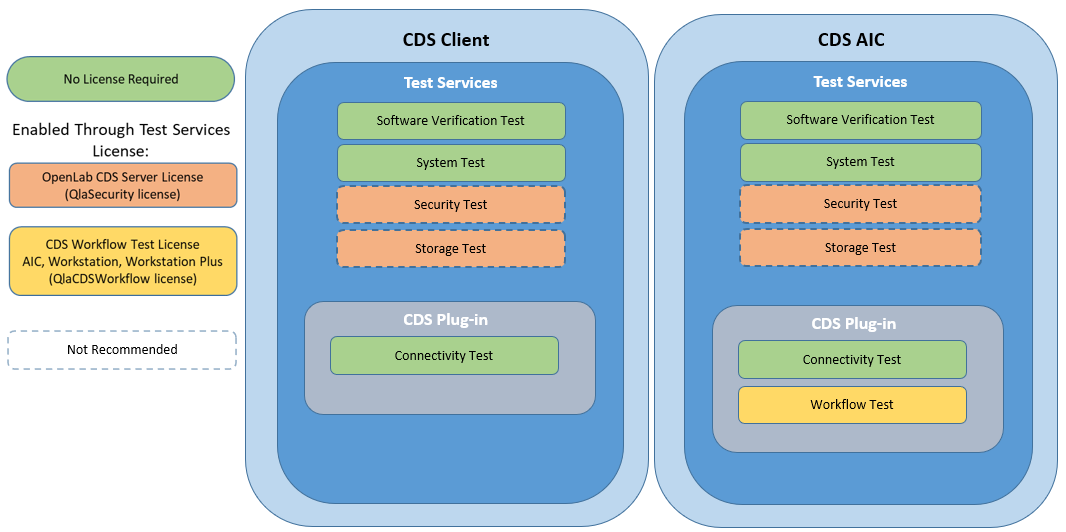
Figure 2. Test Services components on a Client and an AIC. Dashed boxes mark tests that are available but not recommended for that machine type.
OpenLab Server
On an OpenLab Server, Test Services installs the framework tests only: the Software Installation Verification Test, System Report, Security Test, and Storage System Test. The Connectivity Test and Workflow Test, which depend on an instrument controller, are not part of a server deployment. The Security Test and Storage System Test are enabled by the QlaSecurity license.
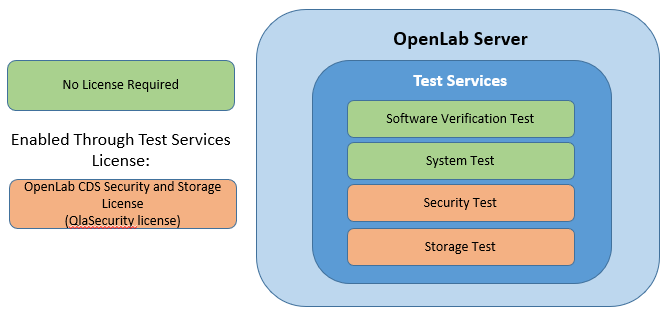
Figure 3. Test Services components on an OpenLab Server: the framework tests only, with the QlaSecurity license enabling the Security and Storage tests.
OpenLab ECM
An OpenLab ECM deployment places Test Services on the OpenLab Shared Services (OLSS) server, alongside a separate ECM server that provides the storage backend. The tests are the same framework set as on an OpenLab Server, and the Storage System Test exercises the ECM storage system.
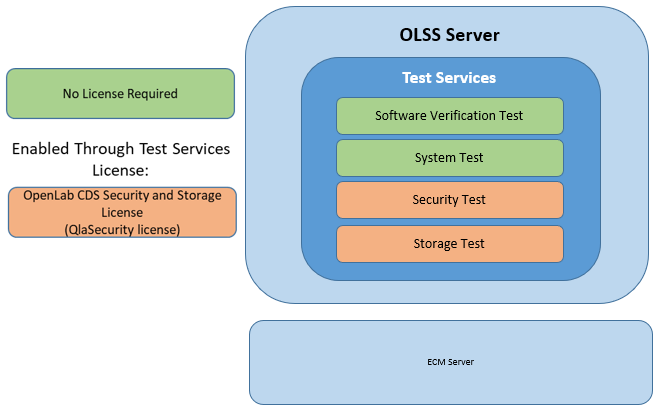
Figure 4. Test Services on the OLSS server in an OpenLab ECM deployment, with the ECM server providing the storage backend.
Reaching Test Services in each topology
Test Services is reached through a browser. The address depends on the machine's role, and a client uses a non-standard port.
Table 1. Test Services address by deployment
| Deployment | Address |
|---|---|
| Server, AIC, Workstation, or Workstation Plus | https://<hostname>.<domain>/testservices or https://localhost/testservices |
| Client (local access) | https://localhost:52088/testservices |
| Client (remote access) | https://<client-fqdn>:52088/testservices |
Replace <hostname>.<domain> with the fully qualified domain name of the server, AIC, or workstation, and <client-fqdn> with the fully qualified domain name of the client.
If a client has a firewall, make sure port 52088 is open. For enterprise OpenLab Server clusters behind a load balancer, the balancer needs extra configuration; see Configure for an enterprise OpenLab Server topology.
See also
- How Test Services works: the deployment model and how a test reaches OpenLab CDS.
- System types and recommended tests: why the recommended set differs by machine type.
- Available tests: every test and where it runs.
- System requirements: supported deployments and platforms.
- Log in to Test Services: logging in at the address for your deployment.
- Configure for an enterprise OpenLab Server topology: load-balancer configuration for clustered servers.